Future of HR
Is the HR Operating Model Still Right for the AI Era?
The Ulrich model reshaped HR for nearly 30 years. But when business changes faster than HR's structure, it is time to redesign HR with AI as a teammate from day one.
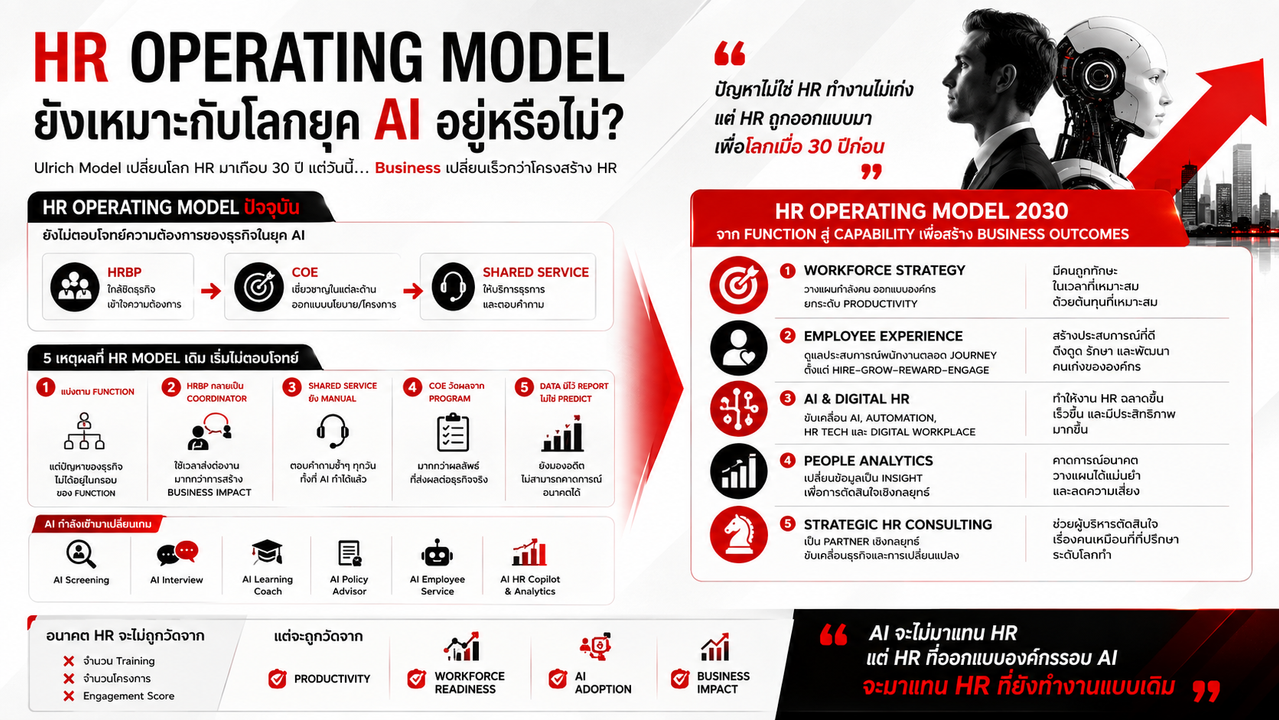
For nearly 30 years, whenever people talked about designing the HR organization, most pictured the Ulrich HR Operating Model — splitting HR into the HR Business Partner (HRBP), the Center of Excellence (COE), and Shared Services. It is widely regarded as the model that meaningfully lifted HR from administrative work toward being a genuine business partner.
The question is: is this model still right for how we work in 2026 and beyond?
My answer is: "It still works, but it is no longer enough." Not because Ulrich's thinking was wrong, but because business now changes faster than the traditional HR structure can keep up with.
When business changes but HR works the same way
The problem organizations face today is not running enough training or hitting recruitment SLAs. Business is wrestling with a different set of questions, such as:
- How do we increase productivity?
- How do we cut cost without cutting organizational capability?
- Which work should be done by AI, and which by people?
- What skills will the organization need in the next 3–5 years?
Yet when business brings these questions, what happens in many organizations is that the request is passed from the HRBP to several COE teams and back to the business again. A process that fit the world of ten years ago is becoming a bottleneck in a world where every decision has to happen within days.
The real problem is not people — it is the design
I see five key limitations in today's HR Operating Model.
1. Designed around functions, not business problems
HR is split into Recruitment, Learning, Compensation, Talent, HRIS, and Employee Relations. But business does not have problems shaped like functions — business has problems shaped like outcomes: falling productivity, stalled sales growth, high turnover, or missing new skills. These challenges need several disciplines working together, not work handed back and forth between teams.
2. The HR Business Partner becomes a coordinator
The HRBP was designed to be a strategic partner. But in many organizations the role has turned into:
- taking requirements
- forwarding them to the COE
- chasing progress
- gathering data
- presenting results
The HRBP spends more time coordinating than helping leaders make business decisions.
3. Shared Services still focuses on answering questions
Even after investing in an HRIS or self-service systems, HR still answers the same questions every day:
- benefits
- leave
- overtime
- employment certificates
- company policy
This work does not create strategic value, and it is work that AI can handle more efficiently.
4. The COE is measured by number of programs, not results
Many organizations run plenty of development curricula, leadership programs, and engagement activities. But the key question is whether these programs create real business results. Do they raise productivity? Do they reduce turnover? Do they grow revenue? In the future, HR will be measured by business impact, not by volume of activity.
5. Data is still just reporting the past
Many organizations have beautiful dashboards, but they still cannot answer:
- Where will we be short of people six months from now?
- Which skills are disappearing from the organization?
- How much cost could AI save us?
- If we double the business, how should the workforce change?
The future of HR is not reporting — it is prediction and scenario planning.
AI is changing HR's operating model
What AI changes is not just the tools — it is changing the role of HR. A large amount of work that used to require people is now being augmented by AI, such as:
- AI candidate screening
- AI interview assistants
- AI learning coaches
- AI compensation benchmarking
- AI policy advisors
- AI HR copilots
- AI employee-service agents
So the question is not "how will HR use AI?" but rather "how will HR redesign the organization when AI becomes a member of the team?"
What should the HR Operating Model look like
I believe the HR of the future should move from splitting by function to building capabilities that answer real business needs.
1. Workforce Strategy
Owns workforce planning, organization design, and productivity analysis, planning the workforce together with business and finance.
2. Employee Experience
Owns the full employee journey — hiring, learning, growth, reward, and retention — organized not by department but from the employee's point of view.
3. AI & Digital HR
A new team owning:
- AI agents
- automation
- HR technology
- the digital workplace
- AI governance
- process transformation
The goal is not just to build systems, but to make HR work smarter and faster.
4. People Analytics
Not a dashboard-building team, but a team that creates insight to help leaders decide, such as:
- workforce forecasting
- predictive turnover
- productivity analytics
- scenario simulation
- AI-driven insights
5. Strategic HR Consulting
The HRBP in a new form — an internal consultant who understands the business, the finances, and the data, and helps leaders make people decisions the way McKinsey or BCG help their clients.
Will Shared Services and the COE disappear?
I don't think they will disappear, but their roles will change significantly.
Shared Services will become Shared Intelligence: AI handles most service work, and humans step in only for the complex cases or the ones that genuinely need judgment.
The COE will step back from operational delivery and focus on:
- governance
- framework design
- innovation
- best practice
- quality assurance
AI produces the work; the COE designs the standards.
It is time for HR to change how it thinks
I believe that within a few years, organizations will no longer ask HR "how many training courses did you run this year?" or "what is our engagement score?" Instead they will ask:
- Did productivity go up?
- Is the workforce ready for the future?
- How much faster has AI made the organization?
- Is our people cost aligned with our growth?
- How is HR creating competitive advantage?
That means the future HR Operating Model will not be designed from the structure of the HR department, but from the capabilities the business needs.
And perhaps the biggest change for HR is not having AI replace people — it is redesigning HR itself, treating AI as "another member of the team" from day one.